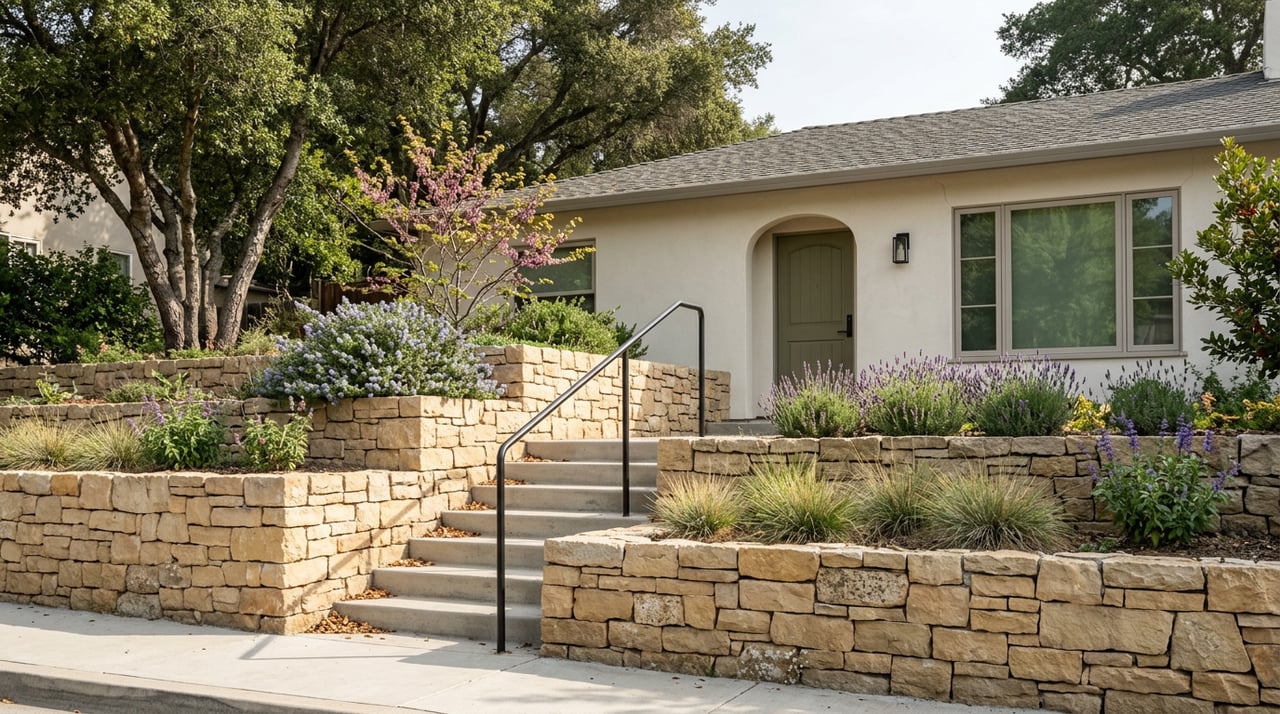
Why did the fastest-selling neighborhood in Orinda also post the steepest price drop of the year, and what does that have to do with a retaining wall bid nobody budgeted for?
If you've been watching Orinda listings from a distance, you've probably seen the same number everywhere: a median sale price hovering around $2 million. It's the figure every portal leads with, and it's not wrong. But it's also not useful on its own, because Orinda isn't one housing market wearing a single price tag. It's at least three, and they've been moving in opposite directions from each other for months.
The Line Item That Doesn't Show Up in the Median
Start with the part buyers usually discover after they're already in contract. Orinda sits on dramatic, oak-covered terrain, and the vast majority of its lots slope. Flat, usable land is the exception here, not the rule. That single fact drives almost everything else in this market, starting with what a hillside purchase actually costs beyond the sale price.
Building or substantially renovating on a sloped Orinda lot typically requires a geotechnical report before anything else happens, usually a few thousand dollars just to find out what the ground will allow. If the report flags slope movement or drainage issues, you're looking at engineered retaining walls, and stabilization work on a serious hillside problem can run from the tens of thousands into six figures. One local stabilization project engineered by Stevens, Ferrone & Bailey involved cast-in-place caissons drilled to 35 feet and tiebacks extending 80 feet to stop a block of bedrock from creeping downhill under an existing home. That's an extreme case, but it illustrates the ceiling on what hillside terrain can demand. Construction cost estimates for Orinda put the hillside premium at 15 to 35 percent above flat-lot building costs, mostly from grading, engineered foundations, and longer permit cycles.
None of that shows up in a median sale price. It shows up three weeks into escrow, when the inspection report lands.
One Median, Three Very Different Markets
Here's where the citywide number starts to fall apart. Redfin's most recent data, updated in June 2026, put Orinda's overall median sale price at $2.0 million over the three months ending in May, up 6.5 percent from the same period a year earlier, with homes selling in 11 days on average compared to 19 days the year before. That's a healthy, competitive market by any read.
But break it into sub-neighborhoods and the picture splits.
| Sub-market | Median Sale Price | Change vs. Year Ago | Days on Market |
|---|---|---|---|
| North Orinda | $2.45M (May 2026) | +32.4% | 19 days |
| Orinda Downs | $2.33M (3 months through May 2026) | -23.1% | 7 days |
| Downtown Orinda | Not separately reported | Homes selling ~2% below list | 38 days |
North Orinda is running hot on price, though homes there took longer to sell than in Orinda Downs. Downtown Orinda took longer to sell than either, with sellers giving up a little ground on price. And Orinda Downs, which is exactly the kind of flat, level pocket buyers seek out precisely because it's rare in this city, sold faster than anywhere else in Orinda while posting the sharpest year-over-year price decline in the same window.
That's the contradiction worth sitting with. The neighborhood with the most demand signal, by far the shortest time on market, also had the softest price. A single citywide median has no way to show you that.
Why Flat Land Doesn't Behave Like the Rest of the City
The explanation isn't that buyers suddenly cooled on flat lots. It's that scarce inventory produces noisy medians. When only a handful of homes trade in a pocket like Orinda Downs in any given quarter, the median isn't measuring the market so much as it's measuring which specific houses happened to close. One older rancher selling below a newer remodel down the street can swing the reported median by hundreds of thousands of dollars, even while the actual competition for that inventory, measured by how fast it moves, keeps accelerating.
This matters because flat lots really are unevenly distributed across Orinda. Orinda Downs has more level land than most of the city. Sleepy Hollow and parts of Glorietta include some flatter parcels as well, which is part of why those pockets carry a premium buyers are willing to pay for easier access and usable yards. Contrast that with Orinda Country Club, known locally as OCC, wrapped around the golf course and Lake Cascade. Homes there often sit on terraced or smaller backyards typical of hillside construction, yet the neighborhood still commands some of the highest prices in the city, with luxury properties ranging from $2.5 million into the $7 million range. The premium there isn't about flat land. It's about the club, the lake, and a setting that's been considered "Old Orinda" since the club's founding in 1924.
So the same city produces two entirely different premium stories: pay more in Orinda Downs because level ground is genuinely scarce, or pay more in OCC because you're buying into water views, golf frontage, and a century of established prestige even though the yard terraces down from the house. A buyer comparing "Orinda" to "Orinda" on paper, using one median, would never see that these are functionally different products.
Downtown Is About to Get More Flat Land, Just Not the Kind You'd Expect
There's a slower-moving story underneath all of this that's worth knowing if you're weighing a purchase near Orinda's walkable core. In November 2025, the Orinda City Council approved rezoning 26 sites in downtown Orinda to allow mixed-use and multifamily residential development, part of the city's court-mandated Housing Element update. The city faced a state deadline in early 2026 to complete these zoning changes or risk losing local control over development approvals through what's known as Builder's Remedy, a state mechanism that lets developers bypass local zoning when a city falls out of compliance.
Separately, Orinda's broader Downtown Precise Plan, which would set design standards for the theatre and village districts, has been tied up since a 2023 lawsuit over wildfire evacuation analysis led a court to order the city to set aside its approval. The Housing Element rezoning moved forward on its own track to meet the state deadline, while the wider Precise Plan remains paused pending revisions. Details on both efforts are available directly from the City of Orinda's Downtown Precise Plan page.
Practically, this means the flattest, most walkable part of Orinda, the part every buyer already wants to be near, is now zoned for more density than it was two years ago. That doesn't change what's for sale today, but it's worth understanding if you're evaluating a downtown-adjacent property for what the neighborhood might look like in five or ten years.
What This Means If You're Actually Shopping
A citywide median tells you almost nothing about which house you should make an offer on. What actually matters is which of these three markets your search sits in, and what that specific pocket has been doing on its own terms. North Orinda's numbers suggest genuine, broad-based demand. Downtown's longer timelines suggest more room to negotiate. Orinda Downs' combination of fast sales and a falling median is a signal to look at the actual comps for a specific street, not the neighborhood-wide number, before you decide whether a listing is priced fairly.
And if hillside terrain is part of your search, which for most of Orinda it will be, build the geotechnical and construction contingency into your thinking before you're three weeks into escrow staring at an engineer's estimate.
A Few Questions Worth Asking Before You Search
Does a higher median always mean more competition for buyers? Not necessarily. Orinda Downs shows the opposite pattern: the fastest sales pace in the city paired with a falling median, because a small number of transactions in a scarce pocket can swing the reported number without reflecting weaker demand.
Is a flat lot in Orinda worth paying more for? It depends on what you're comparing it to. In Orinda Downs, Sleepy Hollow, and parts of Glorietta, the premium reflects genuine land scarcity. In Orinda Country Club, the premium is tied more to the club, the lake, and the setting than to flat ground, since many OCC lots are themselves terraced.
What should I budget beyond the purchase price if I'm buying on a slope? Plan for a geotechnical report early in your due diligence, typically a few thousand dollars, and go in aware that any retaining wall or slope stabilization work uncovered later can range from the tens of thousands into six figures depending on scope.
Every one of these sub-markets requires a different negotiating strategy, and the right one for you depends on details a headline median simply can't carry. If you want a clearer read on what a specific Orinda street or neighborhood is actually doing right now, reach out to Kailani Kimoto and request your free home valuation. It's the fastest way to see where your target property really sits, not where the citywide average says it should.
This article is general information, not legal, tax or financial advice. Consult a qualified professional about your situation.